.jpg)
Current location:Home > Agrochemicals
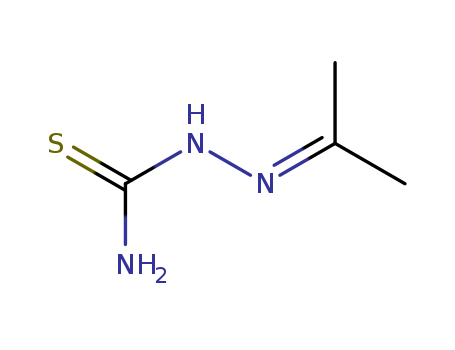
Buy reliable Quality Acetone thiosemicarbazone 1752-30-3 raw material with Honest Price
- Molecular Formula: C4H9N3S
- Molecular Weight: 131.202
- Appearance/Colour: solid
- Vapor Pressure: 0.161mmHg at 25°C
- Melting Point: 174-175 °C
- Refractive Index: 1.569
- Boiling Point: 213.8 °C at 760 mmHg
- PKA: 12.20±0.70(Predicted)
- Flash Point: 83.1 °C
- PSA: 82.50000
- Density: 1.19 g/cm3
- LogP: 1.30660
Acetone thiosemicarbazone(Cas 1752-30-3) Usage
|
General Description |
Solid. |
|
Reactivity Profile |
Acetone thiosemicarbazone may form toxic gases with acids, aldehydes, amides, carbamates, cyanides, inorganic fluorides, halogenated organics, isocyanates, ketones, metals, nitrides, peroxides, phenols, epoxides, acyl halides, and strong oxidizing or reducing agents. May form flammable gases with alkali metals. Explosive combination may occur with strong oxidizing agents, metal salts, peroxides, and sulfides. Emits toxic fumes of oxides of sulfur and nitrogen when heated to decomposition [Sax, 9th ed., 1996, p. 3165]. |
|
Health Hazard |
High oral toxicity. |
|
Fire Hazard |
When heated to decomposition, Acetone thiosemicarbazone emits very toxic fumes of nitrogen oxides and sulfur oxides. Avoid decomposing heat. |
|
Potential Exposure |
Acetone thiosemicarbazone is used as an intermediate in the manufacture of pharmaceuticals and pesticides. May be used as an agricultural chemical. |
|
Shipping |
UN2811 Toxic solids, organic, n.o.s., Hazard Class: 6.1; Labels: 6.1-Poisonous materials, Technical Name Required. |
|
Incompatibilities |
Incompatible with oxidizers (chlorates, nitrates, peroxides, permanganates, perchlorates, chlorine, bromine, fluorine, etc.); contact may cause fires or explosions. Keep away from alkaline materials, strong bases, strong acids, oxoacids, epoxides |
InChI:InChI=1/C4H9N3S/c1-3(2)6-7-4(5)8/h1-2H3,(H3,5,7,8)
1752-30-3 Relevant articles
Growth dynamics and molecular structural analysis of Dimethylketo thiosemicarbazone single crystals for frequency conversion applications - Optical and thermal characterization
Sakunthaladevi,Jothi
, (2021)
New organic Schiff base of Dimethylketo ...
Synthesis and antimicrobial activities of novel 6-(1,3-thiazol-4-yl)-1,3- benzoxazol-2(3H)-one derivatives
Laczkowski, Krzysztof Z.,Misiura, Konrad,Biernasiuk, Anna,Malm, Anna,Grela, Izabela
, p. 41 - 46 (2014)
Synthesis, characterization and investig...
Novel 1,3-thiazolidin-4-one derivatives as promising anti- Candida agents endowed with anti-oxidant and chelating properties
Secci, Daniela,Carradori, Simone,Bizzarri, Bruna,Chimenti, Paola,De Monte, Celeste,Mollica, Adriano,Rivanera, Daniela,Zicari, Alessandra,Mari, Emanuela,Zengin, Gokhan,Aktumsek, Abdurrahman
, p. 144 - 156 (2016)
Pursuing our recent outcomes regarding t...
Unusual chemical transformations of acetone thiosemicarbazone mediated by ruthenium: C-H bond activation, thiolation, and C-N bond cleavage
Paul, Piyali,Seth, Dipravath Kumar,Richmond, Michael G.,Bhattacharya, Samaresh
, p. 1432 - 1440 (2014)
Upon reaction with Ru(PPh3)3Cl2 in ethan...
Synthesis, spectra and crystal structure of two copper(I) complexes of acetonethiosemicarbazone
Lhuachan, Sanchai,Siripaisarnpipat, Sutatip,Chaichit, Narongsak
, p. 263 - 267 (2003)
The reaction of copper(I) chloride with ...
Expedient routes to 1,2,4-triazolinium salts
Fliri, Lukas,Partl, Gabriel,Gelbrich, Thomas,Nerdinger, Sven,Wurst, Klaus,Schottenberger, Herwig
, p. 593 - 610 (2020/01/31)
Concomitant S-alkylation and ketazonatio...
CHEMICAL ACTIVATORS OF NICOTINAMIDE MONONUCLEOTIDE ADENLYLY TRANSFERASE 2 (NMNAT2) AND USES THEREOF
-
Page/Page column 22-23; 28; 32, (2020/06/22)
The present application relates to novel...
THIAZOLE DERIVATIVE AND APPLICATIONS
-
Paragraph 0091-0092, (2019/04/16)
A thiazole derivative serving as a DHODH...
1752-30-3 Process route
-
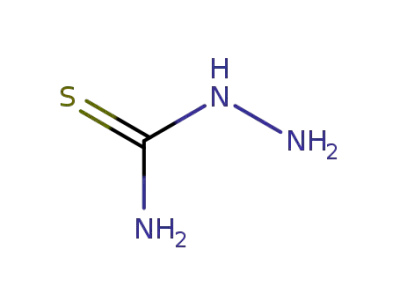
-
79-19-6
thiosemicarbazide

-

-
67-64-1
acetone

-
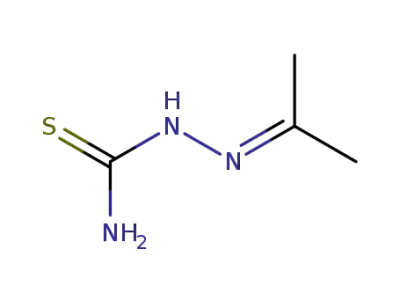
-
1752-30-3
Acetone thiosemicarbazone
| Conditions | Yield |
|---|---|
|
Heating;
|
98%
|
|
In
ethanol; ethyl acetate;
for 16h;
Reflux;
|
96%
|
|
With
acetic acid;
In
ethanol;
for 24h;
Reflux;
|
91.5%
|
|
With
acetic acid;
In
methanol;
for 3h;
Reflux;
|
89%
|
|
With
acetic acid;
In
ethanol;
at 78 ℃;
for 4h;
|
84%
|
|
In
methanol;
|
75%
|
|
|
|
|
In
ethanol;
|
|
|
In
ethanol; water; acetic acid;
Heating;
|
|
|
With
acetic acid;
In
ethanol;
at 20 ℃;
for 24h;
|
|
|
With
acetic acid;
In
ethanol;
at 20 ℃;
|
|
|
With
acetic acid;
In
methanol;
for 3h;
Reflux;
|
|
|
In
ethanol; water;
|
|
|
With
acetic acid;
In
ethanol;
for 24h;
Reflux;
|
|
|
With
acetic acid;
In
ethanol;
at 20 ℃;
|
|
|
thiosemicarbazide; acetone;
With
acetic acid;
In
ethanol;
for 0.00833333h;
In
ethanol;
at 103 ℃;
for 0.0833333h;
Microwave irradiation;
|
|
|
With
acetic acid;
In
ethanol;
at 20 ℃;
|
|
|
With
acetic acid;
In
ethanol;
at 50 ℃;
for 5h;
Reagent/catalyst;
Temperature;
Time;
Microwave irradiation;
|
|
|
With
acetic acid;
In
ethanol;
at 20 ℃;
for 12 - 72h;
|
|
|
With
acetic acid;
In
ethanol;
at 20 ℃;
|
|
|
With
acetic acid;
In
ethanol;
at 20 ℃;
|
|
|
With
acetic acid;
for 7h;
Reflux;
|
|
|
With
hydrogenchloride;
In
ethanol;
|
|
|
With
acetic acid;
In
ethanol;
at 20 ℃;
|
|
|
With
acetic acid;
In
ethanol;
at 20 ℃;
|
|
|
In
methanol;
at 80 ℃;
for 8h;
|
-
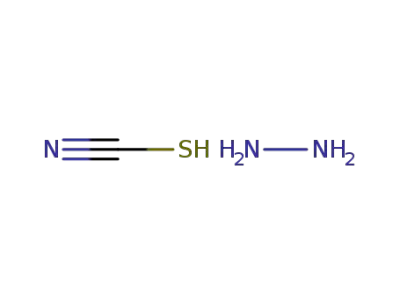
-
24786-78-5
hydrazinium thiocyanate
-
-
67-64-1
acetone
-
-
1752-30-3
Acetone thiosemicarbazone
| Conditions | Yield |
|---|---|
|
With
hydrazine hydrate;
In
water;
at 60 ℃;
Temperature;
|
1752-30-3 Upstream products
-
79-19-6
thiosemicarbazide
-
67-64-1
acetone
-
540-72-7
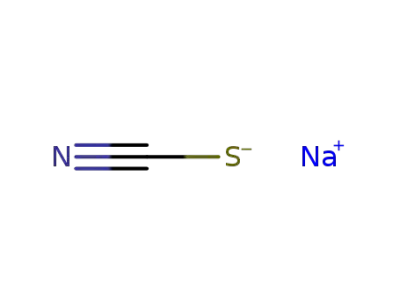
sodium thiocyanide
-
627-70-3

propan-2-one azine
1752-30-3 Downstream products
-
121-55-1
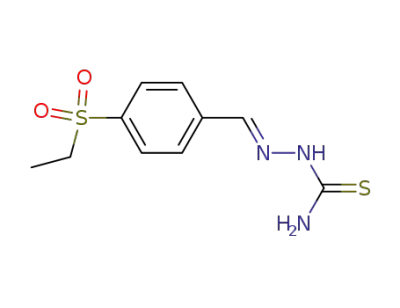
4-ethanesulfonyl-benzaldehyde-thiosemicarbazone
-
14673-56-4
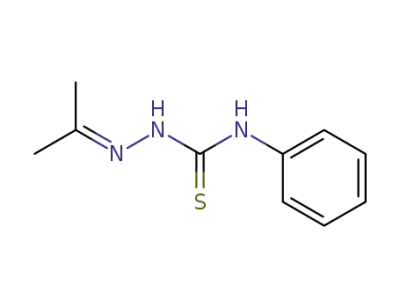
acetone-4-phenylthiosemicarbazone
-
79-19-6
thiosemicarbazide
-
103-02-6
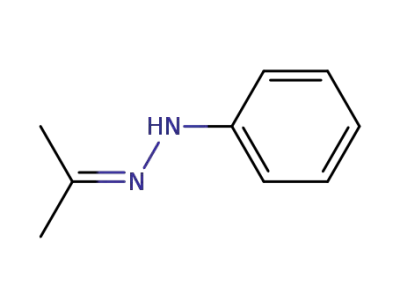
acetone phenylhydrazone